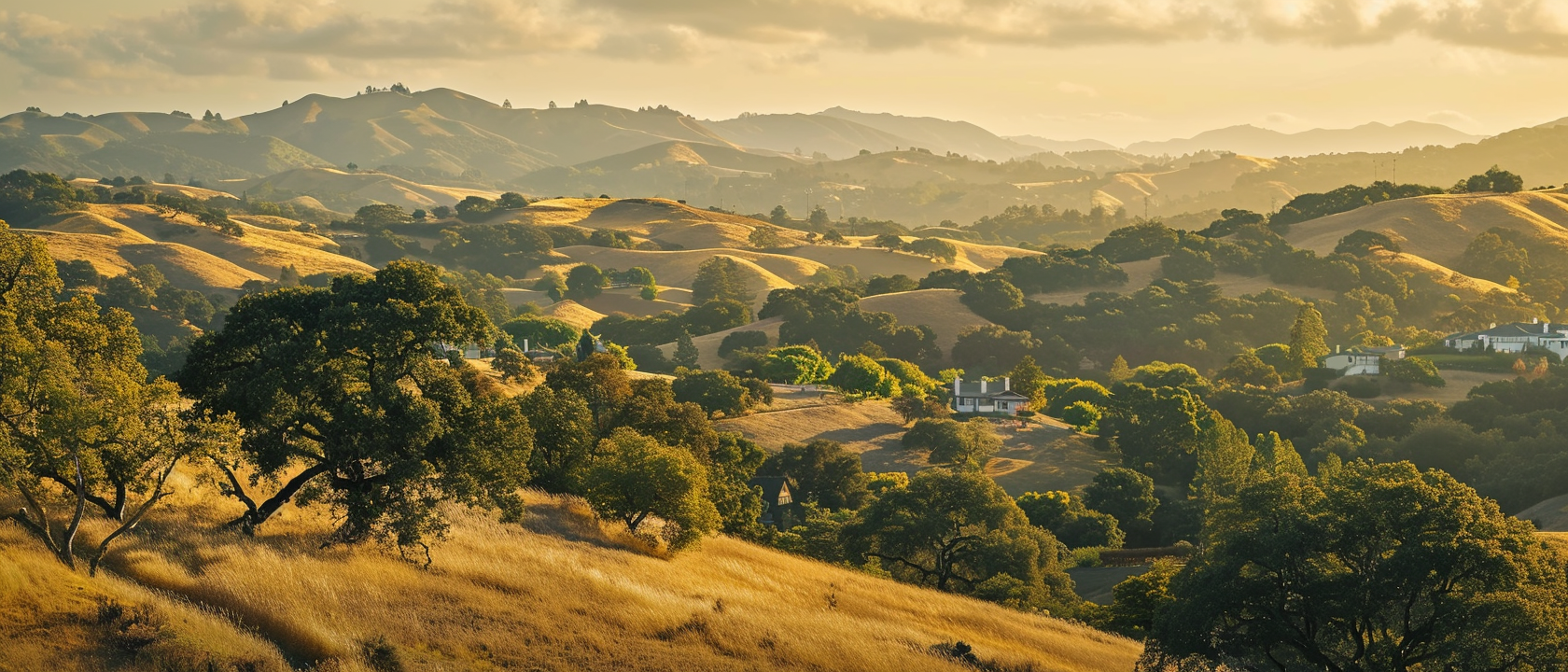
The Caldecott Tunnel is the four-bore highway tunnel that carries Highway 24 through the Berkeley Hills between Oakland and Orinda. For Lamorinda — Lafayette, Moraga, and Orinda — it is the front door. Roughly 170,000–180,000 vehicles pass through it every weekday, and almost every trip into San Francisco, the East Bay flatlands, or Oakland International Airport starts and ends with it.
This is the practical guide: what the bores actually are, how to time your trip, what to do when something goes sideways, and the local-knowledge details that only become obvious after a few hundred crossings.
The Quick Facts
- Location: Highway 24, between Oakland (west portal) and Orinda (east portal)
- Four bores, each two lanes wide
- Bores 1 & 2: opened 1937 (3,610 ft / 1,100 m)
- Bore 3: opened 1964 (3,771 ft / 1,149 m)
- Bore 4: opened 2013 (3,389 ft / 1,033 m) — the longest-awaited public works project in modern Bay Area memory
- Today’s configuration: the two older bores (1 & 2) carry eastbound traffic toward Lamorinda; the two newer bores (3 & 4) carry westbound traffic toward Oakland and San Francisco
- Daily volume: approximately 170,000–180,000 vehicles
- Operated by: Caltrans
- Designated: Oakland Designated Landmark (1980)
- Named for: Thomas E. Caldecott (1878–1951), mayor of Berkeley 1930–1932, Alameda County Supervisor 1933–1945, and president of Joint Highway District 13, which built the original two bores
Why “Caldecott” — the Name
Thomas E. Caldecott was not the engineer who designed the tunnel. He was the politician who, in the 1930s, drove the Joint Highway District that financed and built it. Before the first bores opened in 1937, traffic between Oakland and the central Contra Costa towns crawled over Claremont Canyon (called Harwood Canyon at the time) on a narrow, switchbacked road. The original tunnel — two bores side by side — was a transformative piece of regional infrastructure for its era. Caldecott’s name was attached when the third bore broke ground in the early 1960s.
The fourth bore, opened in November 2013, was a decade-long political and engineering saga that finally fixed the reversible-middle-bore problem (more on that below). It was, depending on whom you ask, either the most important Bay Area transportation project of the 2010s or simply the one that took the longest to argue about.
Bore Configuration — What Changed in 2013
Before the fourth bore opened, the Caldecott had three bores and a daily ritual: the middle bore was reversible, switching direction with the commute. Westbound in the morning, eastbound in the evening. Off-peak hours could shift unpredictably. Drivers approaching the tunnel had to read overhead signage to know which way the middle bore was running.
It worked. It was also a constant source of confusion, occasional head-on collisions before the modern signal system, and a chronic bottleneck.
The fourth bore eliminated all of that. Today:
- Eastbound (toward Lamorinda): Bores 1 & 2 — four lanes total
- Westbound (toward Oakland and SF): Bores 3 & 4 — four lanes total
- No more reversible middle bore. Each direction now gets dedicated capacity around the clock.
This is why locals who have lived here since before 2013 still occasionally say things like “the third bore” with an inflection — they’re remembering the old system. The reversible bore is gone. All four bores are one-way, all day.
Traffic Patterns by Time of Day
Lamorinda commute rhythm is famously predictable. The tunnel reflects it.
Weekdays — School Year (late August through mid-June)
- 6:30 AM – 9:00 AM — Westbound is heavy. Peak is 7:00–8:15 AM. Eastbound is light to moderate.
- 9:00 AM – 11:30 AM — Both directions ease. This is the comfortable midmorning window.
- 11:30 AM – 1:30 PM — Moderate both ways. Lunch-meeting traffic to Oakland and SF picks up.
- 3:00 PM – 4:30 PM — School pickup and early-commute ramp begins. Westbound still moderate; eastbound starts to build.
- 4:30 PM – 7:00 PM — Eastbound is heavy. Peak is 5:00–6:15 PM. Westbound is light by comparison.
- 7:00 PM – 9:00 PM — Both directions ease back. A great window in either direction.
- 9:00 PM – 6:00 AM — Light. The tunnel can feel almost empty at 11 PM on a weeknight.
Weekdays — Summer (mid-June through mid-August)
Peak volumes drop roughly 15–25% during school summer break. The morning westbound peak softens (vacation, remote work, fewer school-related trips). The afternoon eastbound peak still happens but is shorter and less severe. The midmorning window (9:30 AM – 11 AM) becomes the best time to cross in either direction.
Weekends
- Saturday morning — Eastbound builds 8:30–11:00 AM (people heading out to Lamorinda hikes, Lafayette Reservoir, brunch). Westbound is light.
- Saturday afternoon and evening — Westbound builds heading into Oakland and SF for dinner, events, and Giants/A’s games. Eastbound returning traffic peaks 9:00–11:30 PM.
- Sunday — Generally the calmest day of the week in both directions, except during major Bay Area events (Bay to Breakers, Pride, Outside Lands weekend, etc.)
The Variables That Matter
- Giants home games at Oracle Park. Westbound traffic backs up onto 24 for an hour before first pitch; eastbound backs up for 90 minutes after the final out.
- Warriors and Sharks weeknight games. Less Caldecott impact than the Giants (most fans are coming up I-880 or 101), but evening westbound 5:30–7:30 PM is busier on game nights.
- Berkeley graduation weekend (mid-May). Eastbound Sunday afternoon is unusually heavy.
- Acalanes-district graduation weekend (late May/early June). See The Friday the Relatives Land — Friday-afternoon eastbound 3:00–7:00 PM is meaningfully slower as out-of-town families come through. The Saturday around 2 PM is congested in neighborhood traffic, not tunnel traffic.
- Cal football Saturdays. Westbound morning 9:00–11:00 AM, eastbound 5:00–8:00 PM after games.
- First and last days of Burning Man week. Westbound is briefly bizarre with art cars heading to Reno.
Tunnel Incidents — What Happens When It Closes
The Caldecott closes, fully, several times a year. Common causes:
- Vehicle fires (rare but high-impact — a major 1982 tanker fire in the second bore closed it for months)
- Multi-vehicle accidents in a single bore
- Routine maintenance — usually overnight, single-bore closures, well-publicized in advance
- Caltrans emergency response drills — occasional and brief
When a bore closes during commute hours, the impact is severe. With one of two same-direction bores out, capacity for that direction is cut in half. Backups can extend two to three miles upstream within twenty minutes.
The local instinct is wrong. When a tunnel bore is closed during commute hours, the urge is to exit and take surface streets — Tunnel Road, Claremont, Wildcat Canyon. Don’t. Those alternates have a combined capacity of perhaps one-fifth of a single tunnel bore. They saturate immediately. You will be sitting on a twisty residential road for an hour and you will not have a way out.
The exception: if you’re stuck before the Highway 13 / I-580 interchange, you have options. If you’re already past the Fish Ranch Road exit and into the bottleneck, stay on 24 and ride it out.
Alternate Routes (When the Tunnel Is Closed)
You only need to know these if the Caldecott has a major incident. None of them are convenient.
- Highway 13 → I-580 → I-880 → I-980 → I-580 → I-680 — the long bypass, usually 45–60 extra minutes
- Highway 13 → I-580 → I-880 → Bay Bridge → SFO/SF — relevant only if your destination is SF and you don’t need Oakland
- Wildcat Canyon Road (residential, very narrow) — emergency only; locals strongly discourage using this except for trips entirely within the East Bay hills
- Pinehurst Road / Skyline Boulevard — extremely twisty, residential, and slow; not a real alternate for commuters
For the vast majority of closure events, waiting it out is faster than the bypass. Pull off at Orinda Theatre Square (eastbound) or downtown Oakland (westbound), grab a coffee, and watch the live 511 cameras.
Quirks Only Locals Know
- The fourth bore feels faster. It isn’t, objectively — it’s actually the shortest at 3,389 feet — but the LED lighting is brighter and the lane markings are crisper than the older bores, and the perceived speed is real. Locals routinely choose Bore 4 over Bore 3 for psychological reasons.
- Cell signal drops in the second bore. It comes back in the third. Don’t start an important call on Highway 24 westbound at the Lafayette exit.
- The radio cuts out in all four bores. FM static is universal. AM is worse. Most streaming services pause briefly and resume on the other side; some don’t. The locals listen to podcasts on download mode, or know to expect the gap.
- Westbound, the right lane (Bore 4) is faster at peak. Most drivers default into Bore 3 by habit. Bore 4 carries the same volume but flows about 7–10% faster in the AM peak because of this distribution skew.
- Eastbound, the left lane (Bore 2) is faster at peak. Mirror image — habit pushes most drivers right.
- The Highway 24 / Highway 13 interchange just west of the tunnel is the actual chokepoint, not the tunnel itself. When westbound 24 is backed up at 7:45 AM, it’s usually the 13 merge — the tunnel itself is fine. This matters because solo drivers who use the Carpool 13-from-580 connector can sometimes save 6–10 minutes by routing through the 13 junction instead of the 24/Bay Bridge approach.
- Weather: the tunnel itself is weather-immune, but the western approach (downhill into Oakland) gets fog more often than the eastern (uphill into Orinda). The east portal is at roughly 760 feet of elevation; the west portal is at roughly 730 feet — but the approach on the Orinda side rises faster, so the microclimate change between Oakland and Orinda is more dramatic than the elevations suggest.
Going to the Airport — Which Airport?
A common Caldecott question is which Bay Area airport is most reasonable from Lamorinda. The answer depends on the time of day and the direction of the bottleneck.
- OAK (Oakland International) — Closest, typically 25–35 minutes. Pass through the Caldecott once each way. Best off-peak option.
- SFO (San Francisco International) — Farther, typically 50–70 minutes off-peak and 60–90 in traffic. Pass through the Caldecott once each way and cross the Bay Bridge. Best for direct flights east.
- SJC (San Jose International) — Farthest, typically 55–80 minutes. Avoid the Caldecott entirely by going south on I-680. Best for SoCal and Southwest fares.
For a tongue-in-cheek field report on how families navigate this three-airport tax, see The Friday the Relatives Land.
Recent Improvements and Ongoing Work
- Fourth bore (2013) — added 50% more capacity, eliminated the reversible middle bore
- LED lighting retrofits — completed in the older bores 2018–2020
- Ventilation upgrades — continuing through the 2020s
- Pavement rehabilitation — Caltrans periodically resurfaces individual bores during overnight closures; check Caltrans QuickMap and 511.org for the current schedule
Live Conditions
When planning a trip through the tunnel, the most useful real-time resources are:
- 511.org — Bay Area traffic and transit
- Caltrans QuickMap — official incident map with bore-level status
- Google Maps and Apple Maps — both have reliable traffic estimates for Highway 24 specifically
- Twitter / X: @511SFBay and @CHPGoldenGate — incident alerts in real time
The Cultural Note
If you live in Lamorinda, the tunnel becomes part of your interior weather. You measure trips by it. You know its moods. You develop a sixth sense about whether the 4:47 PM eastbound is going to be a 4-minute crossing or an 11-minute crossing. You teach your kids to bring water in case they’re stuck. You apologize to relatives who got snagged in it.
For more on the psychology of all this, see The Psychology of the Caldecott Tunnel and The Friday the Relatives Land.
See Also
- Getting Around Lamorinda — BART, trails, and other routes
- Moving to Lamorinda — commute considerations for prospective residents
- Lafayette · Moraga · Orinda — the three towns east of the tunnel
- Things to Do in Lamorinda — once you’re through the tunnel, here’s the destination guide